

Manganese-Caesium Alum
Difficulty: 4/5
Chemical Composition:
CsMn(SO₄)₂ * 12H₂O
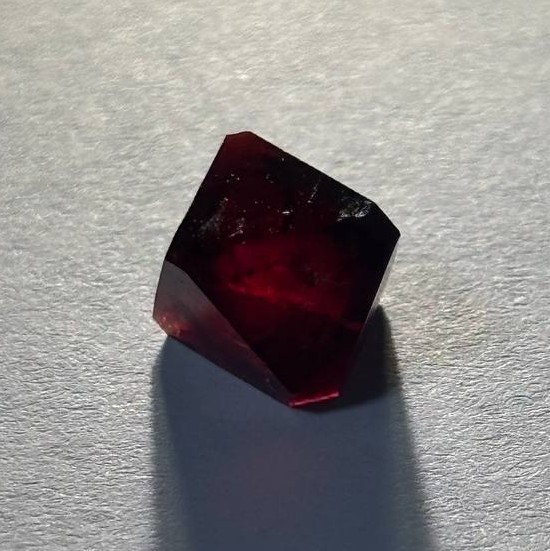
Manganese–Caesium Alum is a distinctive and visually appealing member of the Alum family, valued for its deep red color. In its pure form, this compound typically crystallizes as a well-defined octahedron with triangular sliced edges. Similar to Chromium-based Alums, Manganese–Caesium Alums are intensely colored—often appearing nearly black—so there is little reason to grow them in pure form. The most vivid and aesthetically pleasing coloration can be achieved by mixing Manganese–Caesium Alums with more transparent ones, such as Iron–Caesium Alums. Depending on the concentration of Manganese(III) ions in the solution, the crystal color may vary from orange-red to dark red.
Manganese–Caesium Alum is generally considered difficult to synthesize and grow, but if you are not afraid of a challenge, this tutorial is for you. Its unique deep red color and refined symmetry make it particularly attractive to collectors and crystal growers seeking exotic additions to their collections.
Manganese–Caesium Alum is generally considered difficult to synthesize and grow, but if you are not afraid of a challenge, this tutorial is for you. Its unique deep red color and refined symmetry make it particularly attractive to collectors and crystal growers seeking exotic additions to their collections.
Known Crystal Shapes
Gallery
1 / 6